
White Paper: Subsystems, Meta-Models and Architecture
Posted: 4 9 月, 2026

Executive summary
The meta-model supports the architecture without defining it. Clear, cohesive subsystems with explicit interfaces are what make model-based systems engineering usable at scale.
This white paper distills ten practical insights drawn directly from SystemWeaver experts and practitioners, both at SystemWeaver and customers to SystemWeaver. The insights address one of the most persistent challenges in model-based systems engineering: how to define, communicate, and maintain subsystem boundaries in a way that is meaningful, consistent, and tool-agnostic.
The guidance is organized around three recurring themes: the vocabulary problem (ensuring that “system” and “subsystem” mean the same thing to everyone), the meta-model problem (understanding what blocks, packages, and other constructs do and do not represent), and the structural problem (choosing a leading decomposition and managing overlap across views without losing architectural intent).
Each section closes with a concrete “Guidance” statement that can be shared directly with customers or used to frame onboarding and architecture reviews.
Introduction
When organizations adopt model-based approaches to systems engineering, they quickly encounter a deceptively simple question: what exactly is a subsystem? The word appears in every architecture diagram, every requirement matrix, and every interface control document. Yet its meaning varies widely, even within a single program.
This paper presents ten customer-facing insights developed from experienced SystemWeaver users and consultants. All points are derived directly from this experience; no external theory has been introduced. The intent is to give practitioners and their customers a shared vocabulary and a set of practical heuristics that improve clarity, reduce rework, and make the SystemWeaver meta-model work harder for them.
The guidance is deliberately prescriptive. Systems engineering frameworks often acknowledge that “multiple decompositions are valid” without helping teams decide which one to use. The sections that follow aim to close that gap.
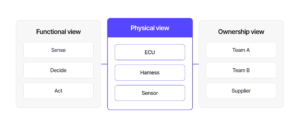
Different decompositions can all be valid
1. Align Early on What is Meant by System and Subsystem
A recurring theme is that customers routinely use the same words, while holding different mental models. This creates invisible misalignment that surfaces only when architecture decisions are already locked in.
- A system should deliver meaningful value to a user or stakeholder on its own.
- A subsystem exists to organize complexity inside a system, not to mirror departments, documents, or tools.
- Organizations frequently mix physical, functional, and organizational interpretations without realizing it.
Guidance: Do not assume shared understanding. Make subsystem definitions explicit at the start of a project, including the rationale for how the system is decomposed.
2. Accept That Different Customers Decompose Systems Differently
Even mature organizations with established processes can produce radically different subsystem structures for similar systems.
- Break systems down using different criteria: electrical, functional, physical, or organizational.
- Believe they follow the same rules while producing very different structures.
- Often cannot recall why the original structure was chosen.
This is not a weakness to be corrected; it is a reality to be managed. Acknowledging it early prevents wasted effort trying to align fundamentally different mental models.
Guidance: There is no universal “correct” subsystem structure. What matters is that the chosen structure is understood, intentional, and consistently applied.
3. Choose a Leading Structure and Make It Explicit
Modern development programs involve many parallel views: requirements, functional architecture, logical architecture, and physical or hardware/software-architecture. Experience from a vast number of projects suggests that one structure must be designated as the leading structure, because:
- Users will inevitably treat the main hierarchy or tree in the model as the subsystem structure, whether that was the intent.
- If the leading structure is unclear, the model becomes confusing regardless of its technical correctness.
- Ownership, responsibility, and integration of accountability all depend on knowing which structure is authoritative.
Guidance: Explicitly decide which structure is authoritative for ownership, responsibility, and integration and ensure all other views relate back to it.
4. Do Not Confuse Meta-Model Elements with Subsystems
A central insight from the meta-model design is that the constructs available in SystemWeaver, namely blocks, packages, functional elements and traceability of links, do not automatically constitute subsystem definitions. In practice:
- Many example models show subsystem requirements and functional elements without surfacing the subsystem structure itself.
- This hides architectural intent and makes ownership unclear.
- Stakeholders who cannot clearly see the subsystem structure will behave as though it does not exist.
Guidance: Subsystems are an architectural decision, not something to be inferred from meta-model constructs. The subsystem structure must be made visible and explicit.
5. Understand What Packages and Blocks Mean in Practice
There are typically a lot of assumptions that practitioners carry without examining them. Two constructs deserve particular attention:
- Packages: typically represent work, delivery scope, or logical grouping. They are not system partitioning and should not be treated as such.
- Blocks: represent architectural elements with defined interfaces. They may exist within subsystems but are not subsystems by default.
When these constructs are used carelessly, the resulting model can look structured while concealing genuine ambiguity about who owns what.
Guidance: Use packages and blocks consciously. Do not rely on them to “become” subsystem definitions unless that is an explicit, documented architectural choice.
6. Expect Overlap Across Domains, But Manage It
Requirements, functional, and physical structures will almost always decompose a system differently. Our experience shows that:
- Overlap across abstraction levels is unavoidable and need not be a problem.
- Problems arise when overlap is implicit, unacknowledged, or unmanaged.
- Independently redefining subsystems in each domain leads to contradictions that are expensive to resolve later.
Guidance: Allow multiple decompositions, but keep subsystem ownership non-overlapping, make cross-domain relationships explicit, and avoid redefining subsystems independently in each domain.
7. Design for High Cohesion and Low Coupling
So, what makes a subsystem boundary “good”? The classical principles of cohesion and coupling remain the most practical test:
- High cohesion: elements within a subsystem belong together and change for related reasons.
- Low coupling: changes in one subsystem should not ripple across many others; interfaces should absorb change.
- Poor boundaries lead to coincidental grouping, where unrelated elements are forced together, amplifying change impact.
This is a practical engineering test, not a theoretical principle. Teams can apply it immediately to existing models by tracing the blast radius of a recent change request.
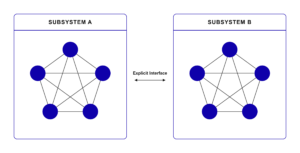
Guidance: Evaluate subsystem boundaries by change impact. If a small change requires updating many subsystems, the decomposition is likely wrong.
8. Use Interfaces to Decouple, Not Hierarchy
A recurring trap in model-based engineering is adding structural depth to solve problems that are interface problems. Our recommendations here are:
- Decoupling is achieved through interfaces, not by creating deeper hierarchies.
- Adding layers or compositions without architectural meaning increases rather than reduces coupling.
- Functional subsystems with strong internal interaction and limited, well-defined external interfaces are more stable over time.
Guidance: Favor clear interface definitions over structural nesting. Structure should carry meaning, not merely satisfy tool requirements or visualization preferences.
9. Constrain the Meta-Model to Keep It Usable
Experience consistently points to the same failure mode: over-flexible meta-models that allow any decomposition to produce models that are impossible to maintain. Specifically:
- Overly flexible meta-models lead to deep, unmanageable hierarchies.
- It becomes unclear what the “atomic” elements of the model are.
- Reporting, scripting, and routine maintenance all degrade as a result.
This is a counter-intuitive point worth emphasizing to customers who equate flexibility with power. A model that can represent anything often ends up reliably representing nothing.
Guidance: Constraints are not limitations, they are enablers. Limit hierarchy depth and decomposition freedom deliberately to preserve clarity and long-term usability.
10. Treat Legacy and Greenfield Contexts Differently
Experience shows a clear distinction between two types of organizations, that require different approaches:
- “Legacy” organizations have accumulated historical meta-model elements that must be supported even when they are suboptimal.
- Greenfield organizations can align subsystem principles and meta-model design from the outset.
- Forcing an idealized architecture onto a legacy environment typically creates resistance and erodes trust.
A pragmatic migration path, “freeze the legacy, grow the new”, is almost always more effective than a wholesale re-architecture.
Guidance: Do not impose idealized architectures on legacy environments. Instead, work pragmatically with existing history while guiding future structures more deliberately.
Conclusion
The ten insights in this paper share a common root: the difference between a model that is structurally tidy and a model that is architecturally clear. Tidiness: consistent use of blocks, well-formed packages, and complete traceability is necessary but not sufficient. Architectural clarity requires an additional layer of deliberate decision-making which structure leads, what a subsystem actually means in this program, and who owns what.
SystemWeaver’s meta-model is designed to support a wide range of engineering contexts. That flexibility is an asset, but it places a corresponding responsibility on the teams that configure and use it. The guidance in this paper is intended to help practitioners and their customers exercise that responsibility well, starting with the vocabulary they use, through the structural choices they make, and into the constraints they impose to keep the model useful over time.
Used consistently, these principles reduce the gap between the model and the real system it represents, making it easier to manage complexity, communicate across teams, and sustain the model as the system evolves.
The meta-model supports the architecture without defining it. Clear, cohesive subsystems with explicit interfaces are what make model-based systems engineering usable at scale.
About SystemWeaver
SystemWeaver provides a centralized platform for managing product overviews, tracking, and functionality. Effective management of the entire lifecycle of a software product requires a system-level approach that encompasses all stages, from conception through design, manufacturing, service, and disposal.